

OAN Staff Cory Hawkins
1:29 PM – Wednesday, January 21, 2026
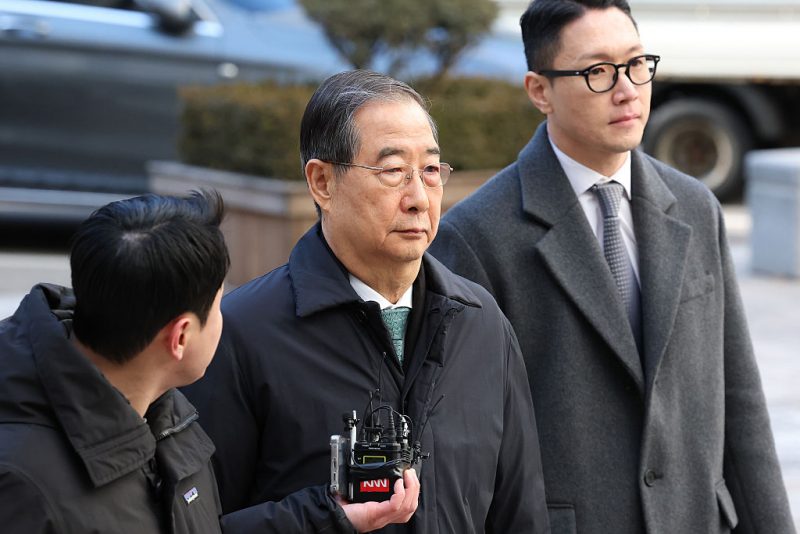
The Seoul Central District Court sentenced South Korea’s former Prime Minister Han Duck-soo to 23 years in prison on Wednesday for his involvement in the martial law declaration imposed by ex-President Yoon Suk Yeol in December 2024.
Han, a career diplomat and two-time prime minister, now holds the distinction of being the first high-ranking Yoon official to be convicted. The court found him guilty of rebellion for attempting to give the martial law decree legal cover via a Cabinet meeting, while also convicting him of perjury and the destruction of evidence.
On the night of December 3, 2024, President Yoon abruptly declared martial law, labeling the opposition-controlled National Assembly a “den of criminals” and accusing lawmakers of being “anti-state forces” and “North Korea followers.” To enforce the decree, he deployed military troops and police to the National Assembly and national election offices, effectively attempting to suspend civilian rule and paralyze parliamentary functions.
Although the declaration sparked immediate, large-scale protests, it lasted only six hours before lawmakers successfully voted to terminate it, avoiding any major violence. The court has since described the event as a “self-coup” aimed at dismantling South Korea’s constitutional order — a move the judiciary likened to the country’s authoritarian era of the 1980s.
The court’s sentence centered on Han’s efforts to drape the decree in a “facade of procedural legitimacy” by orchestrating an emergency Cabinet meeting. Beyond his role in the insurrection, Han was convicted of falsifying and then destroying the official martial law proclamation, in addition to committing perjury.
While he maintains his innocence — asserting that he voiced opposition to Yoon’s plan at the time — the court rejected his defense. In its final judgment, the court ruled that Han neglected his duty as the nation’s second-highest official, choosing instead to gamble on the success of the rebellion rather than upholding his oath.
“Because of the defendant’s action, the Republic of Korea could have returned to a dark past when the basic rights of the people and the liberal democratic order were trampled upon, becoming trapped in the quagmire of dictatorships for an extended period,” Judge Lee Jin-gwan said.
Han became acting president in December 2024 following the impeachment of Yoon. However, Han’s tenure was immediately jeopardized when he was also impeached following a standoff with opposition lawmakers over his refusal to fill vacancies on the Constitutional Court — the body tasked with deciding Yoon’s permanent removal.
Though later reinstated by the Court, Han resigned as acting president in early April 2025 after the justices formally removed Yoon from office.
Han subsequently sought the presidency in the June snap election but withdrew from the race after failing to secure the main conservative party’s nomination. Lee Jae-myung, leader of the liberal party, ultimately won the election.
Currently incarcerated, Yoon faces a litany of criminal charges and ongoing trials. While he has denied all allegations of rebellion, his legal standing remains precarious.
Last week, Yoon was sentenced to five years in prison for obstruction of justice, abuse of power, and the falsification of documents related to his martial law declaration. In a separate insurrection trial, prosecutors have requested the death penalty, with a final verdict scheduled for February 19th.
Stay informed! Receive breaking news blasts directly to your inbox for free. Subscribe here. https://www.oann.com/alerts
What do YOU think? Click here to jump to the comments!
Sponsored Content Below