

OAN Staff Katherine Mosack
11:41 AM – Friday, January 9, 2026
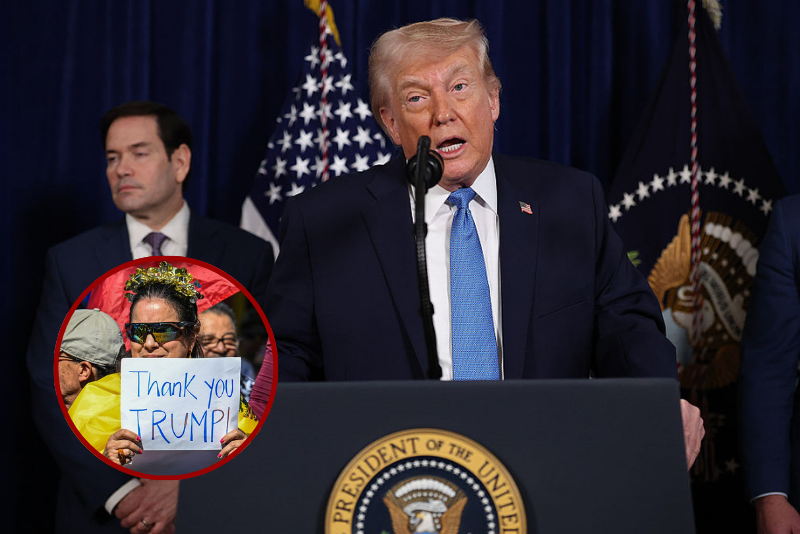
President Donald Trump has canceled a “second wave of attacks” on Venezuela, citing the country’s cooperation with the United States following the capture of Venezuelan President Nicolás Maduro and his wife.
“Venezuela is releasing large numbers of political prisoners as a sign of ‘Seeking Peace,’” Trump posted to Truth Social on Friday morning. “This is a very important and smart gesture.”
“The U.S.A. and Venezuela are working well together, especially as it pertains to rebuilding, in a much bigger, better, and more modern form, their oil and gas infrastructure,” he added, also noting that “At least 100 Billion Dollars will be invested by BIG OIL.”
Early on Saturday morning, the U.S. struck Venezuela’s capital city of Caracas, successfully extracting Maduro and Venezuelan First Lady Cilia Flores as they rushed to a steel-enforced shelter.
Trump announced in a Saturday news conference that his administration would oversee the country until a proper transition of power could be arranged. Secretary of State Marco Rubio had been working with remaining government officials, including Maduro’s Vice President Delcy Rodríguez, who has since been sworn in as interim president.
In the same conference, Trump explained that a “much larger” second attack had been planned, but might be unnecessary due to the success of the first wave.
“Because of this cooperation, I have cancelled the previously expected second Wave of Attacks, which looks like it will not be needed, however, all ships will stay in place for safety and security purposes,” Trump stated.
The Trump administration had been building a military presence near Venezuela’s shores for months, including large naval fleets, fighter jets and thousands of personnel.
As of December 29th, the Venezuelan human rights group Foro Penal stated that Venezuela had 863 political prisoners in custody.
Venezuelan National Assembly President Jorge Rodriguez, brother of Rodriguez, said a “significant number” of people were freed, though it is unclear how many were released, according to the Associated Press.
One released individual was identified as Biago Pilieri, who served on opposition leader María Corina Machado’s 2024 presidential campaign. Another opposition member, 2024 presidential candidate Enrique Márquez, was seen on video hugging Pilieri after their release on Thursday.
Spain’s government also reported five of its citizens were released by Venezuela after two of them, Andrés Martínez and José María Basoa, were arrested by Venezuelan authorities in September 2024, for being Spanish spies aiming to destabilize Maduro’s regime, accusations which Spain denied.
On Saturday evening, the ousted socialist dictator arrived in New York, where he is to stand trial on charges of narcoterrorism.
The U.S. indicted Maduro, along with several members of his regime, in 2020, accusing him of leading the Cartel of the Suns and intentionally flooding other countries, including the U.S., with deadly amounts of cocaine.
To combat this, the War Department has led a campaign of military strikes on alleged drug-trafficking boats since September, and has sunk at least 35 vessels.
During his predecessor, Hugo Chavez’s administration, Venezuela had nationalized its oil production, pushing American oil producers out and away from their infrastructure.
As a result, the Trump administration has seized four oil tankers around Venezuela: The Skipper, Centuries, Bella 1 and Sophia.
Trump also noted in his post that he will meet with U.S. oil giants at the White House on Friday.
Venezuelans, many of whom have fled the country after the establishment of socialism, have erupted in celebrations over the fall of Maduro.
Stay informed! Receive breaking news blasts directly to your inbox for free. Subscribe here. https://www.oann.com/alerts
What do YOU think? Click here to jump to the comments!
Sponsored Content Below