

OAN Staff Blake Wolf
4:35 PM – Tuesday, December 30, 2025
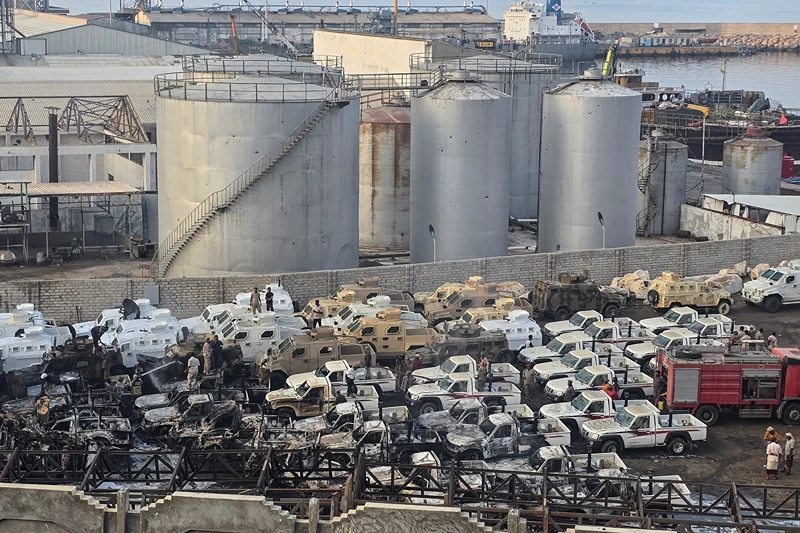
Relations between Saudi Arabia and the United Arab Emirates (UAE) hit a historic low on Tuesday following a Saudi airstrike on a weapons shipment in Mukalla. No causalities have been reported as 4:26 p.m. PT.
Accusing Abu Dhabi of fueling a separatist rebellion, Riyadh’s military action led the UAE to announce the immediate withdrawal of its remaining forces from the Yemen conflict. The UAE, however, denies sending weapons to separatists and maintains that the shipment was intended for its own forces.
After Saudi Arabia launched “limited” airstrikes on Yemen’s port city of Mukalla, accusing its ally, the UAE, of engaging in “highly dangerous” actions in Yemen and threatening stability, the state-run Saudi Press Agency reported that the weapons shipments came from Fujairah in the UAE, intending to support the Emirate-backed separatist group known as the Southern Transitional Council (STC).
“The ships’ crew had disabled tracking devices aboard the vessels, and unloaded a large amount of weapons and combat vehicles in support of the Southern Transitional Council’s forces,” the Saudi military wrote in a statement.
“Considering that the aforementioned weapons constitute an imminent threat, and an escalation that threatens peace and stability, the Coalition Air Force has conducted this morning a limited airstrike that targeted weapons and military vehicles offloaded from the two vessels in Mukalla.”
The airstrikes follow the STC’s recent capture of key eastern governorates, including Hadhramaut and Mahra, which effectively grants the group control over most of South Yemen — a territory that existed as an independent nation from 1967 to 1990.
By seizing Mukalla, the separatists have taken a port city that has served as a critical seat of power for anti-Houthi forces since the 2014 fall of Sanaa. While both Riyadh and Abu Dhabi oppose the Iran-aligned Houthis, their local proxies — the Saudi-backed Presidential Leadership Council (PLC) and the Emirati-backed STC — frequently clash over the country’s future.
In response to the strikes, the UAE announced its voluntary withdrawal from Yemen, urging “restraint and wisdom” while challenging the Saudi allegations.
“I expect a calibrated escalation from both sides. The UAE-backed Southern Transitional Council is likely to respond by consolidating control,” Yemen expert Mohammed al-Basha told the Associated Press. “At the same time, the flow of weapons from the UAE to the STC is set to be curtailed following the port attack, particularly as Saudi Arabia controls the airspace,” he added.
The future of Yemen’s governing coalition remains precarious as the Southern Transitional Council (STC) refuses to relinquish its newly seized territories in the east.
Following the Saudi airstrikes in Mukalla, the PLC officially canceled its security pact with the UAE and issued a 24-hour ultimatum for all Emirati forces to leave the country.
While the UAE complied by announcing a full withdrawal of its counterterrorism teams, the STC — whose leadership also holds seats on the PLC — has rejected the government’s 90-day state of emergency as a ‘unilateral violation’ of power-sharing agreements.
This rupture not only opens a volatile new front, but also pushes the strategic alliance between Saudi Arabia and the UAE to its most severe point of contention in decades.
Stay informed! Receive breaking news blasts directly to your inbox for free. Subscribe here. https://www.oann.com/alerts
What do YOU think? Click here to jump to the comments!
Sponsored Content Below