

OAN Staff Brooke Mallory
12:47 PM – Tuesday, December 16, 2025
The Iowa National Guard on Monday identified two soldiers tragically killed in a Saturday ambush by a lone ISIS gunman in central Syria.
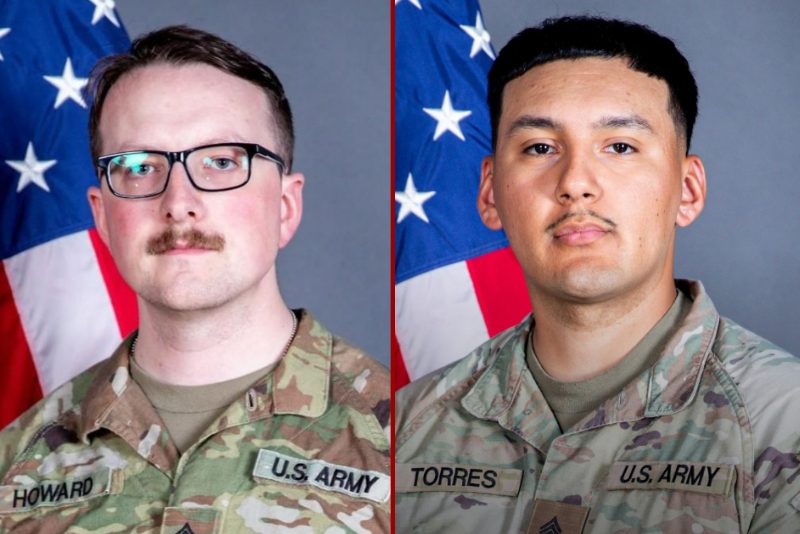
The slain soldiers were identified as Sgt. William Nathaniel Howard, 29, of Marshalltown, Iowa, and Sgt. Edgar Brian Torres-Tovar, 25, of Grimes, Iowa.
The men were deployed on May 28th, Iowa National Guard spokesperson Jackie Schmillen said, and the sergeants belonged to an Iowa Army National Guard unit deployed to the Middle East in support of Operation Inherent Resolve — the U.S.-led mission to combat ISIS.
U.S. Central Command described the attack in a statement as an “ambush by a lone ISIS gunman,” though the specified “gunman was engaged and killed” successfully. The incident occurred during a “key leader engagement” in Palmyra, chief Pentagon spokesperson Sean Parnell explained on social media.
Secretary of War Pete Hegseth also reiterated on social media that “partner forces” neutralized the attacker, while thanking the brave men for their work.
In addition to the aforementioned deaths of the two men, Ayad Sakat, a civilian interpreter who was working with US. forces, was sadly killed as well. Sakat, 54, grew up in a small Catholic village in Iraq and worked for years as an interpreter for the U.S. Army, according to his daughter.
Additionally, three other unidentified U.S. servicemembers were wounded, but are currently recovering.
Sgt. Howard’s father, chief of the Meskwaki Nation Police Department in central Iowa, confirmed his son’s passing in a somber December 13th Facebook post.
“Today two of our Iowa Army National Guard Soldiers were killed in action along with a Civilian Interpreter in Syria,” Bunn said. “My wife Misty and I had that visit from Army Commanders you never want to have. Our son Nate was one of the Soldiers that paid the ultimate sacrifice for all of us, to keep us all safer. He loved what he was doing and would be the first in and last out, no one left behind. Please pray for our Soldiers all around this cruel world. We will see you again son, until then we have if from here,” Chief Jeffrey Bunn wrote.
Syria’s government claimed that the now-deceased ISIS shooter, a member of its security forces, had been investigated days earlier for “possible extremist views.” Nonetheless, President Donald Trump openly promised retaliation as soon as he was briefed on the tragedy.
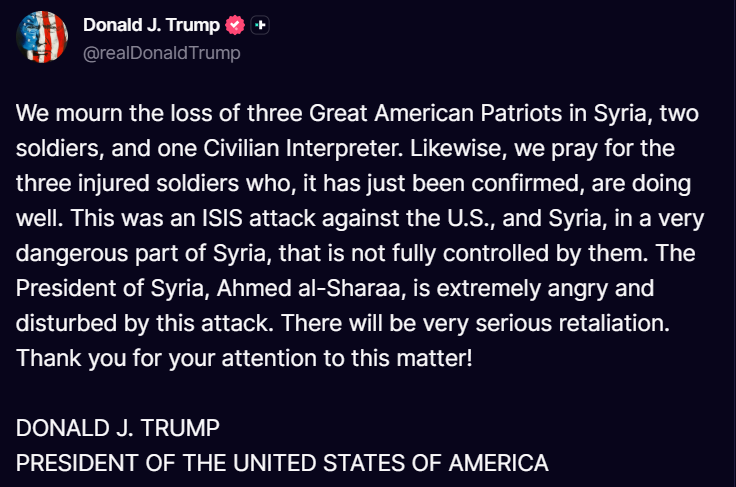
President Trump has developed closer ties with Syrian President Ahmed al-Sharaa, a former jihadist leader whose group originated as an al-Qaeda affiliate in Syria.
After leading Hay’at Tahrir al-Sham (HTS) — which broke ties with al-Qaeda and spearheaded the rebel offensive that overthrew Bashar al-Assad in December last year — al-Sharaa was appointed president of Syria’s transitional government in January this year. He has worked to gain political legitimacy, including engaging with Western leaders and shedding formal militant labels, but whether this amounts to a full reformation has been debated by analysts and Americans alike.
Meanwhile, a former member of the victims’ unit has since warned that the ambush incident could strain U.S.-Syrian relations. The ex-servicemember, speaking anonymously, said it raised anger and questions about preventability.
Joshua Landis, director of the Center for Middle East Studies at the University of Oklahoma, called it a potential reckoning for al-Sharaa.
“He’s telling the West, ‘I embrace you. I want an alliance, and I’m willing to go counter terrorism.’ But he’s telling the Islamists at the same time that he’s not really a part of this Western world, that he’s sticking true to the principles of the religion,” Landis theorized.
Following Assad’s fall, some ISIS fighters infiltrated government security forces, Landis stated, adding that “America’s going to come up with a long list of people they want fired” in relation to the attack.
U.S. forces have operated in Syria against ISIS since 2015, though the U.S. conducted airstrikes against ISIS targets in Syria the year before as well, under former Democrat President Barack Obama.
After ISIS lost its territorial caliphate in 2019, President Trump ordered partial troop drawdowns in the country, reducing U.S. forces from around 2,000 to a sustained level of approximately 900. However, following the overthrow of Bashar al-Assad in December last year, the Pentagon temporarily increased troop levels to about 2,000 before consolidating and reducing them again.
U.S. officials discussed further reductions in Syria, alongside the roughly 2,500 troops in Iraq, but no fixed withdrawal timeline had been established.
Amid ongoing concerns about ISIS resurgence and activity, the Pentagon has since maintained around 900 U.S. troops in Syria as of late 2025, according to recent reports and U.S. Central Command statements on counter-ISIS operations.
Stay informed! Receive breaking news alerts directly to your inbox for free. Subscribe here. https://www.oann.com/alerts
What do YOU think? Click here to jump to the comments!
Sponsored Content Below