

OAN Staff Katherine Mosack
10:08 AM – Wednesday, January 14, 2026
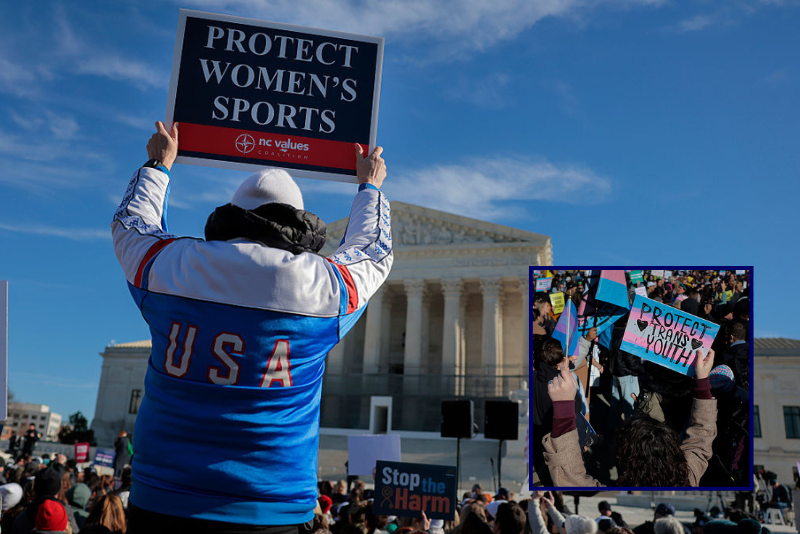
The United States Supreme Court appeared receptive to state laws banning transgender-identifying biological males from playing in female sports while hearing arguments for two different court cases.
On Tuesday, the high court heard three hours of oral arguments for cases in West Virginia and Idaho that call into question the validity of laws designed to protect women and girls in sports from male athletes.
The court first heard Little v. Hecox, filed in 2020 by transgender athlete Lindsay Hecox, who attempted to join the women’s cross-country team at Boise State University. A lower court blocked the law, though the state asked the Supreme Court to determine whether or not laws that protect female athletes violate the Equal Protection Clause of the Fourteenth Amendment.
West Virginia v. B.P.J. concerns West Virginia’s “Save Women’s Sports Act,” which a trans-identifying individual, Becky Pepper-Jackson, is contesting on the basis of having identified as female since the third grade and taking puberty blockers since the early onset of puberty.
Several of the Supreme Court justices had their own arguments that seemed to support the controversial state laws.
Justice Samuel Alito questioned how one could argue against state laws, claiming a violation of equal protection laws based on sex, without a clear definition of sex. He asked Hecox’s attorney, Kathleen Hartnett, to define what it means to be a “boy or a girl or a man or a woman.”
“Well, how can you — how can a court determine whether there’s discrimination on the basis of sex without knowing what sex means for equal protection purposes?” Alito pressed.
The justice also highlighted “an awful lot of female athletes who are strongly opposed to participation by trans athletes in competitions with them.”
“What do you say about them? Are they — are they bigots? Are they deluded in thinking that they are subjected to unfair competition?” he asked.
Justice Brett Kavanaugh, who coached his daughters’ school’s girls’ basketball team for years, considered women’s sports to be “one of the greatest successes in America over the last 50 years.”
“Some states and the federal government and the NCAA (National Collegiate Athletic Association) and the Olympic Committee — so these are a variety of groups who study this issue — think that allowing transgender women and girls to participate will undermine or reverse that amazing success and will, you know, create unfairness…” Kavanaugh said. “Well, for the individual girl who does not make the team or doesn’t get on the stand for the medal or doesn’t make all league, there’s a harm there, and I think we can’t sweep that aside.”
In both oral arguments, Chief Justice John Roberts weighed the broader consequences of creating exceptions to the definition of “female” for sports in specific states.
“If we adopted that, that would have to apply across the board and not simply to the area of athletics,” he noted.
Justice Clarence Thomas asked Idaho Solicitor General Alan Hurst if the state’s law would also apply to “an individual male who is not a good athlete, say, a lousy tennis player” who would try out for the women’s team, having been passed over for the men’s team.
“That’s exactly what we’re concerned about, that their arguments about needing to make exceptions… from an otherwise valid classification for people for whom that classification doesn’t make sense, those arguments don’t limit themselves to people who identify as transgender,” Hurst explained. “Many males could say ‘I can’t really compete with the women’s basketball team, and, therefore, I should be able to try out.’”
Justice Ketanji Brown Jackson, who at her confirmation hearing refused to define the term “woman,” on the grounds that she’s not a biologist, questioned the application of the state law in Idaho.
“The law actually operates differently, I think, for cisgender women and transgender women. That is, with respect to their desire to play on a team that matches their gender identity, cisgender women can do it, transgender women cannot. And so, we do appreciate a distinction, I think, that is being drawn on the basis of your gender status, gender identity status, trans or cis, right?” she asked Hurst.
Jackson employed left-wing terms, cisgender, which refers to biological women, and gender identity, which is defined under leftist gender ideology as a person’s internal sense of being a man, woman, or neither, effectively redefining the term gender as separate from sex.
Riley Gaines, a 25-year-old former collegiate swimmer who became a conservative activist, wondered, based on Justice Brown’s comments, “Is she advocating for one giant category for all?”
“Does she think disabled athletes should compete with able-bodied athletes too? Let’s just combine the Paralympics and the Olympics while we’re at it,” Gaines added in another post on X.
The 6-3 conservative majority is expected to come to a decision by summer.
Stay informed! Receive breaking news alerts directly to your inbox for free. Subscribe here. https://www.oann.com/alerts
What do YOU think? Click here to jump to the comments!
Sponsored Content Below